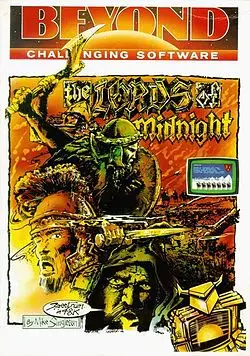
The Lords of Midnight is an award winning adventure video game, written by Mike Singleton, and released in 1984 for the ZX Spectrum. Very well received from the beginning, it was soon converted for the Amstrad CPC and Commodore 64. The game featured an innovative 3-D effect that Singleton called landscaping, which served to bring the player into the game much more than usual. Lords of Midnight is often named with Elite as among the top role playing games of the 1980s.
The Lords of Midnight is a wargame/adventure game. The player starts with four characters (Luxor the Moonprince, Rorthron the Wise, Corleth the Fey, and Morkin), and then has the option to recruit up to twenty-eight further characters (such as Lord Ithrorn, The Utarg of Utarg, Lords Blood, Xajorkith, Shadows, etc. plus Farflame the Dragon Lord, Fawkin the Skulkin, and others) to join in the quest to destroy Doomdark, the evil Witchking who has locked the Land of Midnight in perpetual winter.
The game can be played in three ways. The first is as a straight adventure game, where the goal is for Morkin to destroy the Ice Crown, the source of Doomdark’s power. The second is as a war game, recruiting other lords and their armies until you are strong enough defeat Doomdark’s armies and storm his citadel in the far north. A third variation, referred to in the manual as the ‘Epic’, requires the player to complete the game both ways simultaneously.
The player has an advantage in that only one of the two objectives is needed to defeat Doomdark. The game is won whenever the Ice Crown is destroyed or when Doomdark’s home citadel of Ushgarak falls. For Doomdark to win, he has to complete two objectives. First, he must kill Morkin, Luxor’s son, since as long as Morkin is alive, the game continues. Also, he must subdue the armies of the Free, either by killing Luxor or by conquering Xajorkith, the capital citadel of the Free lands.
The game featured a groundbreaking technique called landscaping to depict the lands of Midnight from a first-person perspective. Also, playing the game may be enjoyed numerous times, since each time Doomdark’s armies can choose to attack from different routes and do not always follow the same pattern.
At the time of its release, game creator Mike Singleton thought there was no way to defeat Doomdark before Xajorkith fell.[citation needed] Gamers quickly proved him wrong, and even now various Internet groups devoted to the game continue to refine their strategies to defeat Doomdark.[1]
Crash published a four-page map of the game in 1984.[2][3]
Hungarian computer magazine called ‘CoV’ also published a full-detailed map, along with a walkthrough in their 19th issue.[4]
Source: TheGamesDB
Specification: Lords of Midnight
|




There are no reviews yet.